Chipotle Chicken Bowl Calories: Nutrition, Protein & Ingredients
A Chipotle chicken bowl can be a filling meal with a good amount of protein, but its calories can change a lot based on what you add. Rice, beans, salsa, cheese, sour cream, guacamole, and other toppings all affect the final number.
Chipotle lists a burrito bowl at 420–910 calories, depending on the ingredients selected. Its current nutrition information lists a 4 oz serving of chicken at 180 calories and 32g of protein.
So, there is no single calorie number that applies to every chicken bowl. The best way to know your total is to look at each ingredient and add the calories together. This guide breaks down those numbers so you can build a bowl that fits your needs.
How Many Calories Are in a Chipotle Chicken Bowl?
A Chipotle chicken bowl can range from a fairly light meal to a much larger meal depending on your order. Chipotle’s published nutrition guide gives a general range of 420–910 calories for a burrito bowl, which shows how much customization can change the total.
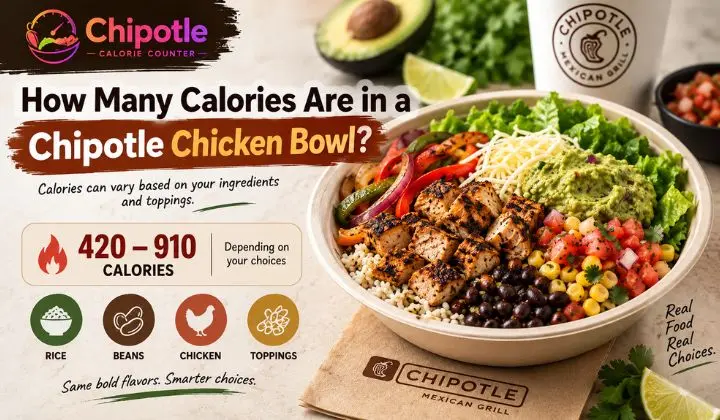
For example, a simple bowl with chicken, rice, beans, salsa, and lettuce will be much lower in calories than a loaded bowl with cheese, sour cream, queso, guacamole, and chips.
The chicken itself adds 180 calories and 32g of protein per 4 oz serving. White and brown cilantro-lime rice are both listed at 210 calories per 4 oz serving. Black beans and pinto beans each add 130 calories per 4 oz serving.
That means the ingredients you choose after the chicken can have a big effect on your final bowl.
Chipotle Chicken Bowl Nutrition Facts
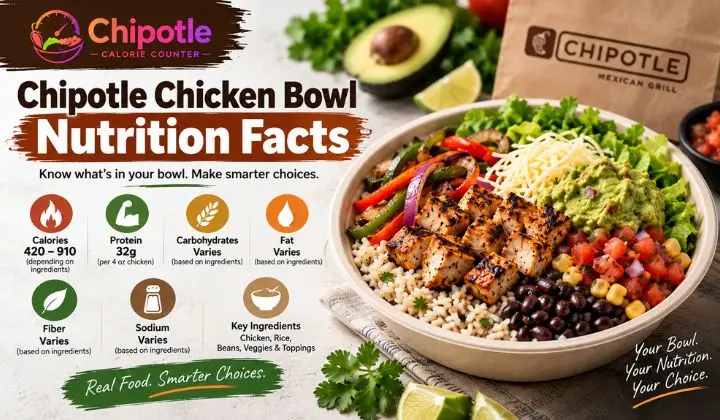
Here is a simple example of how the main ingredients can fit together:
| Ingredient | Calories | Protein |
| Chicken, 4 oz | 180 | 32g |
| White rice, 4 oz | 210 | 4g |
| Black beans, 4 oz | 130 | 8g |
| Fresh tomato salsa, 4 oz | 25 | 0g |
| Fajita vegetables, 2 oz | 20 | 1g |
| Romaine lettuce, 1 oz | 5 | 0g |
| Example total | 570 | 45g |
This example gives you a 570-calorie chicken bowl with 45g of protein before adding cheese, sour cream, guacamole, queso, or other extras.
The exact amount you receive can vary because restaurant portion sizes are not always identical. Chipotle also notes that its nutritional content may vary because of portion size, recipes, ingredients, and other factors.
If you want to check different combinations quickly, a tool such as the Chipotle Nutrition Calculator can make it easier to compare your choices before placing an order.
Chipotle Chicken Bowl Calories by Ingredient
The easiest way to control your bowl is to understand what each ingredient adds. Chipotle’s nutrition information provides calories and other nutrition details for individual menu components.
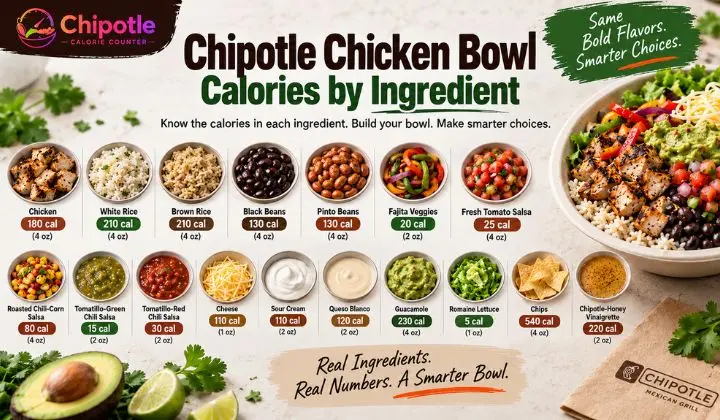
| Bowl ingredient | Serving | Calories |
| Chicken | 4 oz | 180 |
| White rice | 4 oz | 210 |
| Brown rice | 4 oz | 210 |
| Black beans | 4 oz | 130 |
| Pinto beans | 4 oz | 130 |
| Fajita vegetables | 2 oz | 20 |
| Fresh tomato salsa | 4 oz | 25 |
| Roasted chili-corn salsa | 4 oz | 80 |
| Tomatillo-green chili salsa | 2 oz | 15 |
| Tomatillo-red chili salsa | 2 oz | 30 |
| Cheese | 1 oz | 110 |
| Sour cream | 2 oz | 110 |
| Queso Blanco | 2 oz | 120 |
| Guacamole | 4 oz | 230 |
| Romaine lettuce | 1 oz | 5 |
| Chips | 4 oz | 540 |
| Chipotle-Honey Vinaigrette | 2 oz | 220 |
These values come from Chipotle’s published nutrition facts.
Chicken
The Chipotle chicken serving is 4 oz and provides 180 calories and 32g of protein. It is one of the most useful ingredients for a high protein chicken bowl because it adds a large amount of protein without adding as many calories as some of the heavier toppings.
If you choose double chicken, you are adding another serving of chicken. That means the chicken portion alone would provide about 360 calories and 64g of protein, before counting the rest of the bowl.
White Rice and Brown Rice
Both white rice and brown rice are listed at 210 calories per 4 oz serving. The main difference is not calories. Brown rice provides slightly more fiber, while white rice has a slightly different carbohydrate and sodium profile.
So if you are choosing rice only to cut calories, switching from white to brown rice does not create a major calorie difference.
Black Beans and Pinto Beans
Both black beans and pinto beans provide 130 calories per 4 oz serving. They are also useful sources of protein and dietary fiber, making beans a helpful part of a filling bowl.
If your goal is a more satisfying meal, beans can be a better use of calories than adding several high-calorie toppings.
Fajita Vegetables and Salsa
Fajita veggies add only 20 calories per 2 oz serving. Fresh tomato salsa adds 25 calories, while the green and red salsas add 15 and 30 calories respectively. The roasted chili-corn salsa is higher at 80 calories.
These options can add flavor without making your bowl as calorie-heavy as cheese, sour cream, queso, or guacamole.
Cheese, Sour Cream, Queso and Guacamole
The creamy toppings can add up quickly. Cheese and sour cream each add 110 calories in their listed entrée portions, while queso blanco adds 120 calories. A standard guacamole topping is listed at 230 calories.
This does not mean you have to avoid these foods. It simply means they should be counted when you are trying to understand your total Chipotle chicken bowl calories.
Chips and Vinaigrette
Chips and dressing can change a bowl’s calorie total very quickly. Chipotle lists regular chips at 540 calories and its Chipotle-Honey Vinaigrette at 220 calories.
If you are trying to keep your bowl lighter, these are two of the easiest extras to leave out or have separately.
How Many Calories Are in a Chipotle Chicken Bowl With Rice and Beans?
A bowl with chicken, rice, and beans already has a solid base before you add salsa or other toppings.
Using the published serving sizes:
- Chicken: 180 calories
- White rice: 210 calories
- Black beans: 130 calories
That combination comes to 520 calories before salsa, vegetables, lettuce, cheese, sour cream, queso, or guacamole.
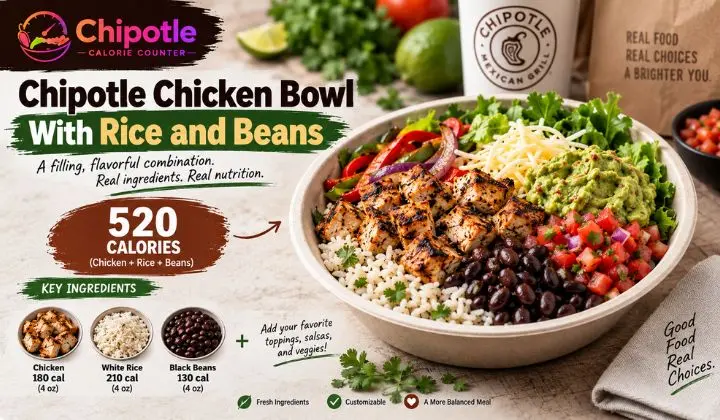
Add fresh tomato salsa at 25 calories, fajita vegetables at 20 calories, and romaine lettuce at 5 calories, and the total becomes 570 calories.
This is a useful example because it shows how a basic chicken bowl with rice and beans can provide a substantial meal without needing every available topping.
White Rice vs. Brown Rice
For calories, there is no major difference. Chipotle lists both cilantro-lime white rice and cilantro-lime brown rice at 210 calories per 4 oz serving.
The better choice depends on what you want from your meal. Brown rice has slightly more fiber, while white rice can still fit easily into a balanced bowl.
Black Beans vs. Pinto Beans
Black beans and pinto beans are also very close in calories. Each has 130 calories per 4 oz serving, with both providing 8g of protein. Pinto beans provide slightly more fiber in the published nutrition data.
So the choice can come down to taste and the rest of your meal rather than calories alone.
How Much Protein Is in a Chipotle Chicken Bowl?
A Chipotle chicken bowl protein total depends on the full order, but the chicken gives the bowl a strong starting point.
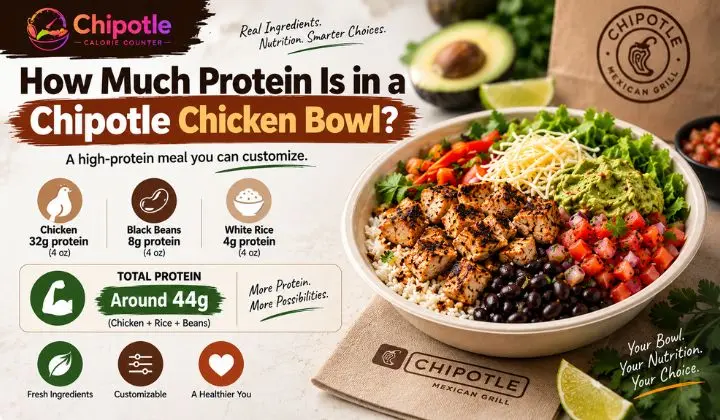
A 4 oz serving of chicken provides 32g of protein. Black beans or pinto beans add another 8g of protein per 4 oz serving, and rice adds 4g.
For example:
- Chicken: 32g protein
- White rice: 4g
- Black beans: 8g
- Fresh tomato salsa: 0g
- Fajita vegetables: 1g
- Lettuce: 0g
That simple bowl provides about 45g of protein.
If you want a high protein Chipotle bowl, adding another chicken serving is one of the clearest ways to increase protein. Two standard chicken servings would provide about 64g of protein from chicken alone.
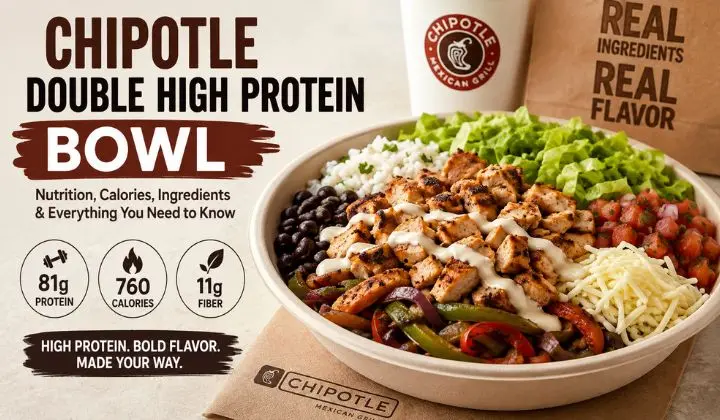
Chipotle also currently promotes a Double High Protein Bowl with double chicken and other ingredients, listed at 81g of protein and 760 calories. That is a specific menu build, though, so it should not be treated as the nutrition value for every chicken bowl.
The key point is simple: protein comes mostly from your protein choice and beans, while rice, vegetables, and toppings make smaller contributions.
How to Build a Lower-Calorie Chipotle Chicken Bowl
You do not have to skip a Chipotle chicken bowl to keep calories lower. The easiest approach is to choose filling ingredients that add flavor and protein without loading the bowl with several high-calorie extras.
Start with Chipotle chicken, then add fajita vegetables, salsa, and romaine lettuce. You can include rice and beans too, but the final calorie count will depend on your portion choices.
A simple lower-calorie build can include:
| Ingredient | Calories |
| Chicken | 180 |
| Fajita vegetables | 20 |
| Fresh tomato salsa | 25 |
| Tomatillo-green chili salsa | 15 |
| Romaine lettuce | 5 |
| Black beans | 130 |
| Total | 375 |
This example gives you a flavorful bowl at about 375 calories before adding rice or other toppings. It also provides protein from the chicken and beans, while vegetables and salsa add volume and flavor.
If you want rice, remember that a standard serving of either white or brown rice adds 210 calories. You can still enjoy rice, but knowing its calorie contribution helps you decide what else to add.
Which Toppings Should You Watch?
The biggest calorie increases often come from toppings rather than salsa or vegetables. Guacamole adds 230 calories, while queso blanco, cheese, and sour cream add 120, 110, and 110 calories respectively.
You do not need to remove every topping. Instead, choose the ones you enjoy most and consider skipping other extras. For example, adding guacamole while leaving out cheese and sour cream can keep the bowl simpler while still giving you a creamy topping.
How to Build a High-Protein Chipotle Chicken Bowl
A high protein Chipotle bowl is easy to build because chicken already provides a large amount of protein.
A standard 4 oz serving of chicken provides 32g of protein. Adding beans and other ingredients can push the total higher. If you choose double chicken, the chicken alone provides about 64g of protein based on two standard servings.
A practical high-protein build could include:
- Double chicken
- Black beans
- White or brown rice
- Fajita vegetables
- Fresh tomato salsa
- Romaine lettuce
Using the published serving values, two chicken servings provide about 360 calories and 64g of protein. One serving of black beans adds 130 calories and 8g of protein, while rice adds 210 calories and 4g of protein.
That makes the base about 700 calories and 76g of protein, before counting the vegetables, salsa, and lettuce.
This is a good example of why a bowl’s nutrition depends on the complete order. A Chipotle chicken bowl with double chicken can have very different nutrition from a bowl with a single chicken serving and several calorie-dense toppings.
What Comes in a Chipotle Chicken Bowl?
One of the main benefits of a bowl is customization. Instead of receiving one fixed combination, you choose the ingredients that make up your meal.
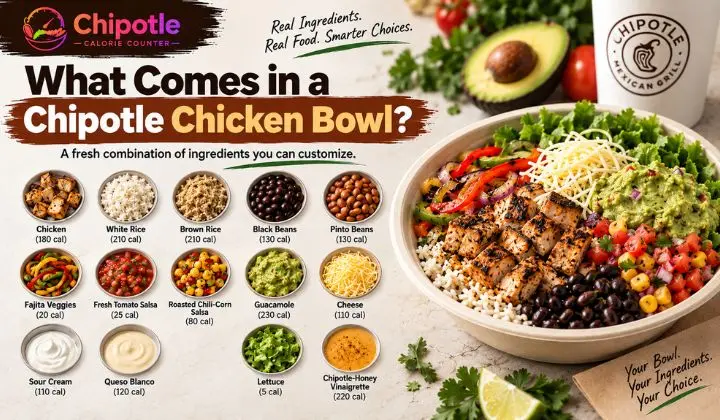
The main Chipotle chicken bowl ingredients include:
- Chicken
- White rice
- Brown rice
- Black beans
- Pinto beans
- Fajita vegetables
- Fresh tomato salsa
- Roasted chili-corn salsa
- Tomatillo-green chili salsa
- Tomatillo-red chili salsa
- Cheese
- Queso Blanco
- Sour cream
- Guacamole
- Romaine lettuce
You can build a simple bowl with chicken, rice, beans, salsa, and lettuce, or add several Chipotle chicken bowl toppings for a larger meal.
The important thing is that every addition changes the nutrition. For someone watching calories, knowing the ingredients is just as important as knowing the starting calorie count.
Is a Chipotle Chicken Bowl Healthy?
A Chipotle chicken bowl can be part of a balanced meal, but whether it is a good fit depends on how you build it and what you need from the meal.
Chicken provides a strong source of protein, while beans can add protein and fiber. Vegetables and salsa can add flavor and volume without the large calorie increase that comes from some creamy toppings.
The main thing to watch is how quickly calories can increase when several extras are added together. For example, guacamole, cheese, sour cream, queso, chips, and vinaigrette all add a significant number of calories.
Sodium is another factor worth considering. A bowl can contain a large amount of sodium depending on the ingredients selected, so looking at the full nutrition facts is more useful than judging the meal by calories alone.
What Makes a Chicken Bowl More Balanced?
A simple approach is to include:
- A good protein source
- Beans for protein and fiber
- Vegetables
- Salsa for flavor
- A reasonable portion of rice
- The toppings you enjoy most
There is no need to label every ingredient as good or bad. A balanced choice depends on your overall meal and your personal nutrition goals.
Chipotle Chicken Bowl vs. Chicken Burrito
A chicken bowl and chicken burrito can contain many of the same ingredients, but the biggest difference is the flour tortilla.
With a bowl, you can choose chicken, rice, beans, salsa, vegetables, and other toppings without adding a tortilla. A burrito wraps those ingredients inside a tortilla, which adds calories and carbohydrates to the meal.
| Feature | Chicken Bowl | Chicken Burrito |
| Flour tortilla | No | Yes |
| Chicken | Yes | Yes |
| Rice | Optional | Optional |
| Beans | Optional | Optional |
| Salsa | Optional | Optional |
| Customization | High | High |
| Calorie control | Depends on build | Depends on build |
A bowl is often easier to customize when you want more control over individual ingredients. However, the total calories still depend on what you put inside it.
Frequently Asked Questions
Can You Get a Chipotle Chicken Bowl Without Rice?
Yes. You can order a chicken bowl without rice and build it with chicken, beans, vegetables, salsa, and lettuce instead. Skipping rice removes its 210-calorie serving from the example builds above.
This can be useful if you prefer a lower-calorie or lower-carbohydrate bowl, while still keeping chicken and other filling ingredients.
Which Chipotle Toppings Add the Most Calories to a Chicken Bowl?
Among the common toppings listed in Chipotle’s nutrition information, guacamole, chips, and vinaigrette add some of the most calories. Guacamole has 230 calories, chips have 540 calories, and the vinaigrette has 220 calories per listed serving.
Cheese, sour cream, and queso also add over 100 calories each, so using several of these together can increase the total quickly.
Does Brown Rice Have Fewer Calories Than White Rice at Chipotle?
No. Chipotle lists both its white rice and brown rice at 210 calories per 4 oz serving. Therefore, switching from white to brown rice does not provide a meaningful calorie reduction.
The choice can instead come down to taste and the small differences in their nutrition profiles, including fiber.
What Is the Lowest-Calorie Salsa for a Chipotle Chicken Bowl?
Based on the listed serving values, tomatillo-green chili salsa has 15 calories per 2 oz serving, making it the lowest-calorie salsa among the options listed here.
Fresh tomato salsa is also relatively low at 25 calories, while tomatillo-red chili salsa has 30 calories and roasted chili-corn salsa has 80 calories.
Can You Order a Chipotle Chicken Bowl With No Beans?
Yes. Beans are optional, so you can build your chicken bowl without black or pinto beans. Removing a standard bean serving saves about 130 calories based on Chipotle’s published nutrition values.
If you skip beans, you can still add vegetables, salsa, and lettuce for more flavor and volume.
How Can You Make a Chipotle Chicken Bowl More Filling Without Adding Many Calories?
Start with vegetables, salsa, and lettuce because these ingredients add flavor and volume without the large calorie increase of some heavier toppings. Fajita vegetables and romaine lettuce are especially low in calories.
Beans can also make the meal more filling while adding protein and fiber, although they do add 130 calories per listed serving.
Conclusion
A Chipotle chicken bowl can be a simple, high-protein meal or a much larger, calorie-heavy order. There is no single calorie number because your rice, beans, salsa, toppings, and extras all change the final total.
For a lighter bowl, focus on chicken, vegetables, salsa, and lettuce, and be mindful of calorie-dense extras such as guacamole, cheese, sour cream, queso, chips, and vinaigrette. For more protein, chicken and beans are two of the easiest ingredients to build around.
The best approach is not to avoid every topping. Instead, understand what each ingredient adds and build your bowl around your own calorie, protein, and nutrition needs.