Chipotle Burrito Calories: How Many Calories Are in a Burrito?
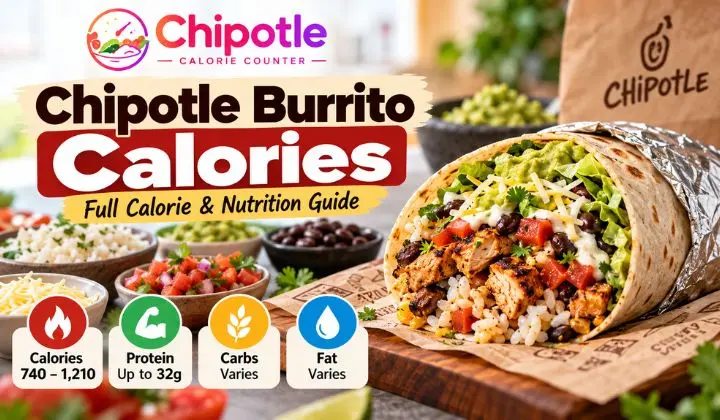
If you are checking Chipotle burrito calories, the most important thing to know is that there is no single calorie count for every burrito. Your total depends on the ingredients you choose, including the flour tortilla, protein, rice, beans, cheese, sour cream, guacamole, queso, salsa, and vegetables.
Chipotle’s published nutrition information shows that a burrito can range from 740 to 1,210 calories, depending on the ingredients selected.
The tortilla alone makes a big difference. A Chipotle flour burrito tortilla contains 320 calories, so the rest of your ingredients are added on top of that.
In this guide, we will break down Chipotle burrito nutrition, show the calories in common ingredients, and explain how different choices can change your total.
A Chipotle burrito can contain about 740–1,210 calories, but your exact total depends on your custom order.
How Many Calories Are in a Chipotle Burrito?
So, how many calories in a Chipotle burrito?
There is no universal answer because Chipotle lets you build your burrito with different proteins, rice, beans, salsas, and toppings.
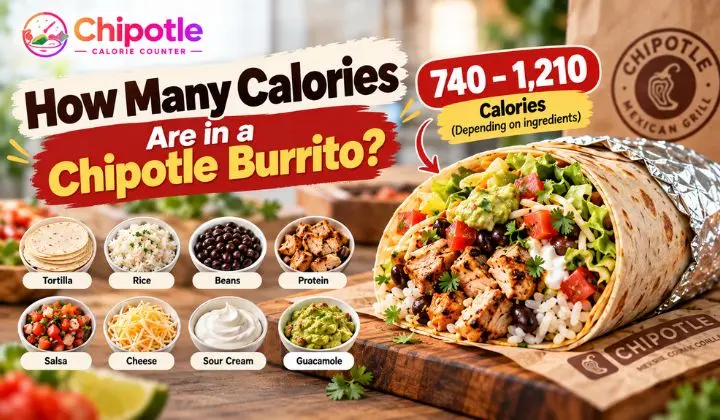
A burrito starts with a flour tortilla and then gets its main calories from the fillings. For example, the current Chipotle nutrition information lists the flour tortilla at 320 calories, white rice at 210 calories, black or pinto beans at 130 calories, and chicken at 180 calories per listed serving.
That means even before adding cheese, sour cream, guacamole, or queso, the ingredients can add up quickly.
Why Do Chipotle Burrito Calories Vary?
The main reason is customization.
One person may order a burrito with:
- Flour tortilla
- Chicken
- Rice
- Beans
- Salsa
- Lettuce
Another person may add:
- Cheese
- Sour cream
- Guacamole
- Queso
- Corn salsa
Both are Chipotle burritos, but their calorie count can be very different.
For example, Chipotle lists guacamole at 230 calories, while cheese and sour cream are each 110 calories and queso blanco is 120 calories per listed serving.
So when someone asks how many calories is a burrito at Chipotle, the better answer is to look at the ingredients rather than assume every burrito has the same calories.
Chipotle Burrito Calories by Ingredient
Understanding the calories in each ingredient makes it much easier to estimate your own Chipotle burrito calories.
The table below uses Chipotle’s published nutrition information. Serving sizes are different for some ingredients, so the values should be treated as individual ingredient servings rather than a fixed amount for every custom order.
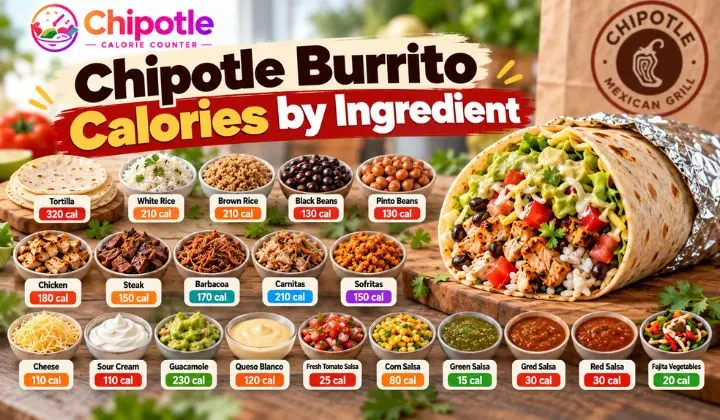
Chipotle Burrito Ingredient Nutrition Table
| Ingredient | Serving | Calories | Protein | Carbs | Fat |
| Flour tortilla | 1 tortilla | 320 | 8g | 50g | 9g |
| White rice | 4 oz | 210 | 4g | 40g | 4g |
| Brown rice | 4 oz | 210 | 4g | 36g | 6g |
| Black beans | 4 oz | 130 | 8g | 22g | 1.5g |
| Pinto beans | 4 oz | 130 | 8g | 21g | 1.5g |
| Chicken | 4 oz | 180 | 32g | 0g | 7g |
| Steak | 4 oz | 150 | 21g | 1g | 6g |
| Barbacoa | 4 oz | 170 | 24g | 2g | 7g |
| Carnitas | 4 oz | 210 | 23g | 0g | 12g |
| Sofritas | 4 oz | 150 | 8g | 9g | 10g |
| Fajita vegetables | 2 oz | 20 | 1g | 5g | 0g |
| Fresh tomato salsa | 4 oz | 25 | 0g | 4g | 0g |
| Corn salsa | 4 oz | 80 | 3g | 16g | 1.5g |
| Green chili salsa | 2 fl oz | 15 | 0g | 4g | 0g |
| Red chili salsa | 2 fl oz | 30 | 0g | 4g | 0g |
| Cheese | 1 oz | 110 | 6g | 1g | 8g |
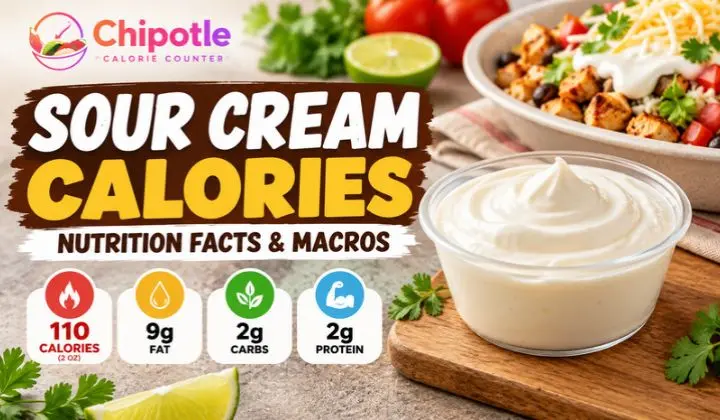
| Sour cream | 2 oz | 110 | 2g | 2g | 9g |
| Guacamole | 4 oz | 230 | 2g | 8g | 22g |
| Queso blanco | 2 oz | 120 | 5g | 4g | 9g |
Flour Tortilla
The Chipotle burrito tortilla calories are an important part of the total.
One flour tortilla contains 320 calories, along with 50g of carbohydrates, 9g of fat, and 8g of protein.
Because the tortilla is already a substantial part of the meal, choosing a bowl instead of a burrito removes this particular calorie source.
Rice
Chipotle lists both white rice and brown rice at 210 calories per 4 oz serving.
White rice provides 40g of carbohydrates, while brown rice provides 36g. Both options provide 4g of protein per listed serving.
If you include both a tortilla and rice, you are adding 530 calories before adding protein, beans, or toppings.
That is why rice can have a noticeable effect on the final calorie breakdown.
Beans
Both black beans and pinto beans provide 130 calories per listed 4 oz serving.
They also provide 8g of protein and a useful amount of dietary fiber. Black beans provide 7g of fiber, while pinto beans provide 8g.
Beans therefore add calories and carbohydrates, but they also contribute protein and fiber to the meal.
Protein
Your protein choice can change both the calories and macronutrients in your burrito.
Chipotle lists:
- Chicken: 180 calories and 32g protein
- Steak: 150 calories and 21g protein
- Barbacoa: 170 calories and 24g protein
- Carnitas: 210 calories and 23g protein
- Sofritas: 150 calories and 8g protein
These values are based on Chipotle’s listed 4 oz servings.
This is why Chipotle burrito protein can vary considerably between different orders.
Cheese, Sour Cream, Guacamole and Queso
Some toppings have a much bigger effect on calories than others.
Chipotle currently lists:
- Cheese: 110 calories
- Sour cream: 110 calories
- Guacamole: 230 calories
- Queso blanco: 120 calories
Guacamole is particularly important when calculating the total because one listed serving adds 230 calories.
If you add cheese, sour cream, guacamole, and queso to the same burrito, these four toppings alone can contribute 570 calories.
That is one reason a heavily loaded burrito can have a much higher calorie count than a simpler order.
Salsas and Fajita Vegetables
Not every topping adds a lot of calories.
Chipotle lists fajita vegetables at 20 calories, fresh tomato salsa at 25 calories, green chili salsa at 15 calories, and red chili salsa at 30 calories per their listed serving sizes.
Corn salsa is higher at 80 calories per listed serving.
This means you can add vegetables and salsa for more flavor without adding the same number of calories as ingredients such as guacamole, cheese, or sour cream.
Chipotle Burrito Nutrition Facts
Calories are only one part of Chipotle burrito nutrition facts.
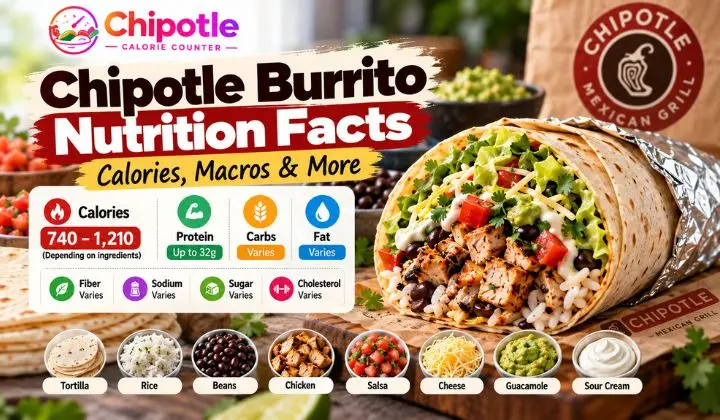
If you are tracking your food, you may also want to know the amount of protein, carbohydrates, fat, fiber, sodium, and other nutrients in your meal.
Since a burrito is customizable, its final burrito nutrition depends on the ingredients and serving sizes in your order.
How Much Protein Is in a Chipotle Burrito?
There is no single number for Chipotle burrito protein because different protein choices provide different amounts.
Chicken provides 32g of protein per listed 4 oz serving, while steak provides 21g, barbacoa provides 24g, and carnitas provide 23g. Beans and the tortilla add additional protein.
For example, a burrito containing chicken, beans, and a flour tortilla gets protein from all three ingredients.
If protein is your main goal, looking at the complete ingredient combination is more useful than relying on an average burrito number.
How Many Carbs Are in a Chipotle Burrito?
Chipotle burrito carbs can also vary significantly.
The flour tortilla contains 50g of carbohydrates. White rice adds 40g, brown rice adds 36g, and black beans add 22g per listed serving.
So a burrito containing a tortilla, rice, and beans can get a large share of its carbohydrates from these three ingredients alone.
Your final carbohydrate total will depend on the rest of your toppings and protein choice.
How Much Fat Is in a Chipotle Burrito?
The amount of fat depends heavily on your selected ingredients.
The flour tortilla contains 9g of fat, while chicken contains 7g, steak 6g, and carnitas 12g per listed serving.
Toppings can add even more. Guacamole provides 22g of fat, sour cream provides 9g, and cheese provides 8g per listed serving.
This is why two burritos with similar calorie totals can still have different macros.
Fiber and Sodium
Fiber and sodium are also important parts of complete burrito nutritional information.
Black beans provide 7g of fiber and pinto beans provide 8g per listed serving. Guacamole provides 6g of fiber.
Sodium can also add up across several ingredients. The tortilla, protein, beans, cheese, salsa, and other toppings can each contribute sodium to the final meal.
If you track sodium or daily value, check the nutrition information for the complete combination rather than looking at calories alone.
Chipotle Burrito Calories by Protein
Your choice of protein can change both the calorie count and protein content of a burrito. Chipotle currently lists chicken at 180 calories, steak at 150 calories, barbacoa at 170 calories, carnitas at 210 calories, and sofritas at 150 calories per 4 oz serving.
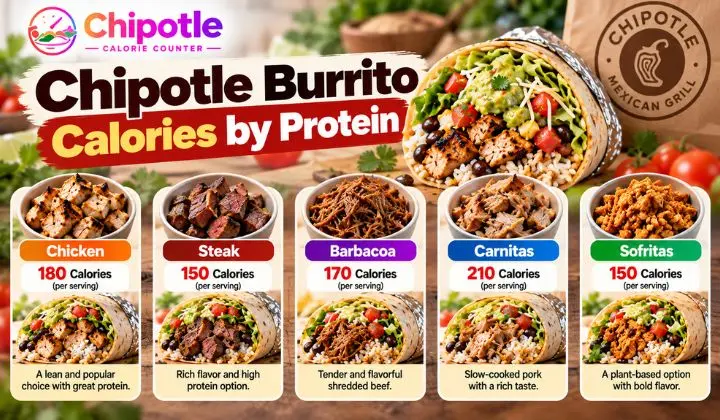
The protein is only one part of the meal, though. The tortilla, rice, beans, cheese, sauces, and other toppings still need to be added to get the full Chipotle burrito nutrition picture.
Chipotle Chicken Burrito Calories
A Chipotle chicken burrito starts with a 320-calorie flour tortilla and 180 calories of chicken before the other ingredients are added.
Chicken is one of the higher-protein choices. Chipotle lists 32g of protein for its 4 oz chicken serving, so it can be a useful choice if you want a high-protein burrito.
The final Chipotle chicken burrito calories depend on everything else you add. Rice, beans, cheese, sour cream, guacamole, queso, and salsa can all change the total.
For example, adding both rice and beans gives you another 340 calories before toppings. This shows why saying “a chicken burrito has X calories” without knowing the complete order can be misleading.
Chipotle Steak Burrito Calories
A Chipotle steak burrito uses 150 calories of steak per listed 4 oz serving.
That is slightly lower than the listed chicken serving, but the difference in the final burrito can be much larger or smaller depending on the other ingredients.
For example, a steak burrito with rice, beans, cheese, and sour cream will have a very different calorie count from one with steak, fajita vegetables, salsa, and lettuce.
Chipotle lists steak at 21g of protein per 4 oz serving.
So when comparing Chipotle steak burrito calories with chicken, focus on the complete build rather than the protein alone.
Chipotle Veggie Burrito Calories
A Chipotle veggie burrito can mean a few different things. You can build a vegetarian burrito with rice, beans, fajita vegetables, salsa, cheese, and other vegetarian toppings. Chipotle also offers a veggie option that includes guacamole.
Sofritas are another option for people looking for a plant-based protein. Chipotle lists sofritas at 150 calories per 4 oz serving.
This means veggie burrito calories at Chipotle depend heavily on whether you use sofritas, beans, guacamole, cheese, rice, and other toppings.
A veggie burrito is not automatically low in calories. Ingredients such as guacamole, cheese, rice, and the flour tortilla can still add a significant amount to the meal.
Barbacoa and Carnitas Burrito Calories
Chipotle lists barbacoa at 170 calories and carnitas at 210 calories per 4 oz serving.
Carnitas therefore contribute more calories than chicken, steak, or barbacoa at the listed serving size.
However, the protein choice is only one part of the calorie breakdown. A carnitas burrito with lighter toppings could have fewer calories than a chicken burrito loaded with several high-calorie toppings.
This is why it is better to calculate the complete meal instead of judging a burrito only by its protein.
How Many Calories Are in a Chipotle Burrito With No Rice?
Removing rice is one simple way to reduce the calories in a burrito.
Chipotle currently lists both white and brown rice at 210 calories per 4 oz serving.
So, if your normal burrito includes one serving of rice and you remove it, you can remove about 210 calories from the ingredient-level calculation.
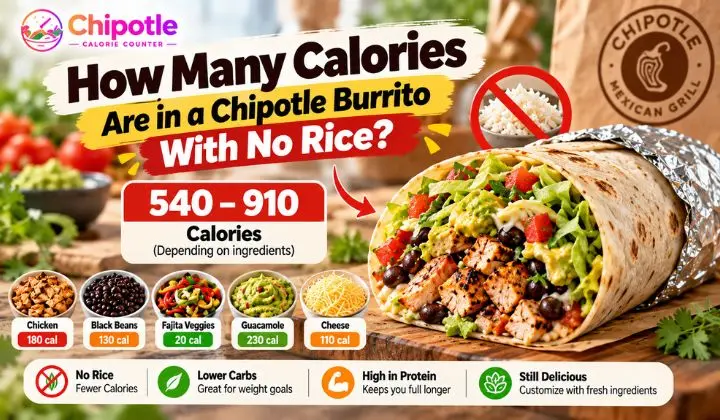
For example:
Flour tortilla + chicken + black beans + salsa + lettuce
will contain fewer calories than the same burrito with a serving of rice added.
You can also replace the space with fajita vegetables, salsa, or lettuce if you still want a filling burrito.
The exact total still depends on the rest of your order, but the main idea is simple: Chipotle burrito calories no rice can be lower because you have removed one 210-calorie ingredient.
Chipotle Burrito Calories vs. Burrito Bowl
One of the easiest comparisons is a burrito versus a bowl.
Chipotle describes a burrito bowl as essentially the same style of meal served in a bowl without the tortilla. Its published nutrition range is currently 420–910 calories, compared with 740–1,210 calories for a burrito.
| Meal | Published calorie range | Main difference |
| Burrito | 740–1,210 cal | Includes flour tortilla |
| Burrito bowl | 420–910 cal | No flour tortilla |
The difference is important because the flour tortilla alone contributes 320 calories.
However, a bowl is not automatically a low-calorie meal. If you fill it with rice, beans, cheese, guacamole, queso, sour cream, and other toppings, the calories can still become high.
The main advantage is that you can remove the tortilla while keeping many of the same fillings.
So when comparing Chipotle burrito bowl calories with burrito calories, always compare the complete ingredients, not just the meal name.
How to Build a Lower-Calorie Chipotle Burrito
If you want a burrito with fewer calories, you do not have to remove every ingredient you enjoy.
Instead, focus on the ingredients that make the biggest difference.
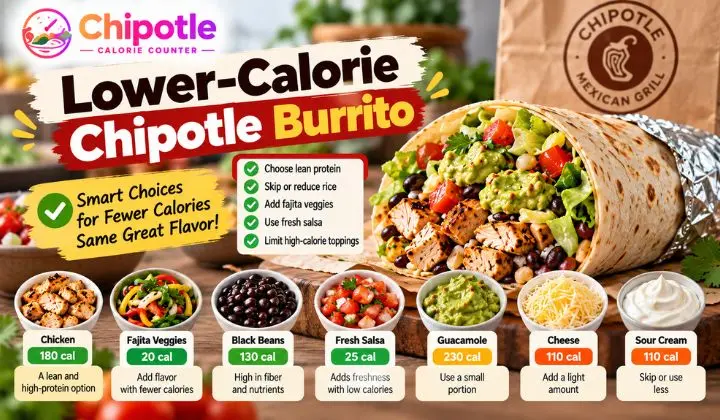
Choose Your Protein Carefully
Start with a protein that fits your goal.
Chicken is listed at 180 calories and 32g of protein, while steak is 150 calories and 21g of protein per 4 oz serving.
The best choice depends on what you want from your meal, so look at both calories and protein instead of choosing based on calories alone.
Reduce or Skip Rice
Rice adds 210 calories per listed serving.
You can ask for no rice or choose a lighter amount if available. You can then add vegetables and salsa for more flavor and volume.
Add Fajita Vegetables and Salsa
Fajita vegetables are a simple way to add vegetables without adding many calories.
Fresh tomato salsa and other salsas can also add flavor while keeping the calorie contribution relatively small compared with cheese, sour cream, guacamole, or queso.
Watch Calorie-Dense Toppings
This is where a burrito can change quickly.
Guacamole is listed at 230 calories, while cheese, sour cream, and queso blanco also add significant calories.
You do not have to avoid these foods. The important thing is to understand how they affect your total.
Example of a Lower-Calorie Burrito
A simple build could include:
Flour tortilla + chicken + black beans + fajita vegetables + fresh tomato salsa + lettuce
This keeps the meal focused on protein, beans, vegetables, and salsa without adding several calorie-dense toppings.
Your exact total should still be calculated using the current ingredient values and the portions in your order.
How to Build a High-Protein Chipotle Burrito
A high-protein Chipotle burrito can be built by focusing on protein-rich ingredients while keeping the rest of the meal balanced.
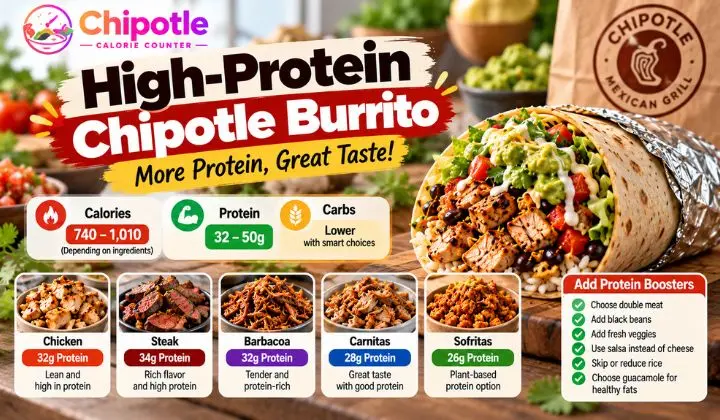
Chicken is particularly high in protein, with 32g of protein per 4 oz serving according to Chipotle’s current nutrition information.
Beans can add another 8g of protein per listed serving, while the flour tortilla contributes 8g.
A simple high-protein build could therefore include:
- Flour tortilla
- Chicken
- Black or pinto beans
- Fajita vegetables
- Fresh tomato salsa
- Lettuce
If you choose extra protein, remember that this also increases the total calorie count.
The goal is not simply to maximize protein. You should look at the complete Chipotle burrito macros, including calories, protein, carbohydrates, and fat.
How to Calculate Your Exact Chipotle Burrito Calories
Because every Chipotle burrito can be customized, calculating your own order is more useful than relying on an average number.
The basic formula is:
Tortilla + Protein + Rice + Beans + Toppings + Salsas = Total Calories
For example, you can calculate your order in this order:
- Start with the flour tortilla.
- Add your chosen protein.
- Add white or brown rice, or select no rice.
- Add black or pinto beans.
- Add fajita vegetables and salsa.
- Add cheese, sour cream, guacamole, or queso.
- Add all ingredient calories together.
This gives you a much clearer calorie breakdown for your specific burrito.
If you want a faster way to check your order, you can use the Chipotle Nutrition Calculator to build your meal and estimate its nutrition before you order.
Frequently Asked Questions
Can You Get a Chipotle Burrito Without Rice?
Yes. Chipotle allows you to customize the ingredients in your burrito, including choosing no rice. Since a listed serving of rice contains 210 calories, removing it can lower the total calorie count of your meal.
What Makes a Chipotle Burrito High in Calories?
The biggest calorie increases usually come from combining several higher-calorie ingredients. The flour tortilla, rice, guacamole, cheese, sour cream, and queso can add a substantial amount before smaller toppings are included.
Does Removing the Tortilla Make a Chipotle Burrito Lower in Calories?
Yes. A burrito bowl removes the flour tortilla while keeping the basic idea of a customized burrito meal. Since Chipotle lists its flour tortilla at 320 calories, removing it can make a major difference in the total.
Can a Chipotle Burrito Be High in Protein and Still Have Fewer Calories?
Yes. You can focus on protein-rich ingredients while limiting some higher-calorie toppings. For example, chicken provides 32g of protein for 180 calories per listed 4 oz serving, while beans add protein and fiber.
Why Can Two Chipotle Burritos Have Very Different Calorie Counts?
Chipotle burritos are customizable, so two customers can choose completely different ingredients. One may include only protein, beans, vegetables, and salsa, while another may add rice, cheese, sour cream, guacamole, and queso.
Conclusion
Chipotle burrito calories can vary a lot because every burrito is customizable. The current official U.S. nutrition information lists a burrito range of 740–1,210 calories.
The easiest way to understand your meal is to look at each ingredient separately. The flour tortilla, rice, protein, beans, cheese, sour cream, guacamole, queso, and salsa all contribute to the final calorie count and nutrition facts.
If you want to lower calories, reducing rice or high-calorie toppings can make a noticeable difference. If your focus is protein, choose a protein-rich option and combine it with beans and other foods that fit your overall meal.
Most importantly, there is no single “perfect” Chipotle burrito. Your best choice depends on your own calorie, protein, carbohydrate, and dietary needs. Using the ingredient-level numbers makes it easier to understand exactly what is in your order.